

Amazon Prime Video’s sci-fi library in 2026 offers something rare: a mix of cerebral classics and contemporary blockbusters that cuts across every flavor of the genre, from Spielberg’s wonder-filled Close Encounters of the Third Kind to the philosophical labyrinth of Mr. Nobody. The challenge isn’t finding sci-fi on the platform; it’s knowing which films deserve your time when the catalog includes everything from awards-season heavyweights like Dune: Part Two to cult favorites like Event Horizon.
This guide cuts through the scrolling fatigue with 15 hand-picked recommendations organized by what you’re actually looking for: mind-bending narratives, spectacular visuals, character-driven stories, or pure escapism. We’ve pulled from both critical darlings (Ad Astra, Cloud Atlas) and recent arrivals (Mickey 17, Companion) to give you options whether you’re settling in for a solo viewing session or need something that’ll spark conversation with fellow film lovers.
The beauty of Prime’s current sci-fi selection is its range. You can explore the ambitious world-building of The Creator one night and revisit the Marvel epic Avengers: Endgame the next. Each recommendation includes what makes it worth watching and who’ll enjoy it most, so you spend less time hunting and more time experiencing the genre at its best.
How We Curated This Sci-Fi Selection
We didn’t just scroll through Prime Video’s sci-fi catalog and pick the first fifteen titles we saw. Building this list meant balancing what critics love with what actually delivers a great viewing experience, mixing eras and styles so there’s something for every mood, and making sure each film was genuinely available to stream on Prime Video in 2026.
Our selection process focused on five key criteria:
- Critical reception and audience scores to ensure quality viewing experiences
- Genre diversity spanning classic space operas, cerebral puzzlers, and action-packed adventures
- Availability confirmed on Prime Video as of 2026, not rotating titles that might disappear
- Balance between mainstream blockbusters everyone’s heard of and hidden gems worth discovering
- Community input from fellow sci-fi fans about what resonates and what feels fresh
That last point matters more than you might think. We’re part of a community of movie lovers who actually watch this stuff, debate it in the comments, and share what works. If three people tell us a particular film changed how they think about AI or made them cry during a space scene, that carries weight alongside the Rotten Tomatoes score.
The result is a mix that respects sci-fi’s roots while celebrating where the genre’s headed. You’ll find Spielberg alongside newer directors pushing boundaries, introspective character studies next to massive visual spectacles, and films that scared us sitting beside ones that filled us with wonder.
Classic Sci-Fi Masterpieces
1. Close Encounters of the Third Kind (1977), Spielberg’s Wonder-Filled Vision
Spielberg’s 1977 masterpiece remains the gold standard for first contact stories, trading alien invasion tropes for genuine wonder and curiosity. The film follows Roy Neary, an ordinary electrical lineman whose chance encounter with a UFO transforms into an all-consuming obsession. What sets this apart is Spielberg’s restraint: instead of revealing the aliens early or resorting to spectacle, he builds tension through mystery and the psychological toll on Roy and other witnesses.
The film’s visual language speaks volumes. Those iconic five-tone musical sequences replace traditional dialogue between species, suggesting communication through art rather than words. John Williams’ score doesn’t just accompany the action, it becomes the bridge between humanity and the unknown. The climactic Devil’s Tower sequence, with its choreographed light show and childlike sense of discovery, encapsulates everything great sci-fi should be: imaginative, hopeful, and fundamentally human in its yearning to connect with something larger than ourselves. Close Encounters proves you don’t need explosions or dystopia to make compelling science fiction, sometimes wonder is enough.
2. Event Horizon (1997), Space Horror Done Right
Paul W.S. Anderson’s Event Horizon remains one of sci-fi horror’s most unsettling achievements nearly three decades after its release. The film follows a rescue crew investigating a missing starship that reappears after seven years, only to discover it’s brought something nightmarish back from beyond known space. What makes it work is the visceral collision of sterile spaceship corridors with genuine cosmic dread, Anderson understood that the cleanest environments make the bloodiest violations more disturbing.
The production design deserves special mention: the Event Horizon itself feels like a gothic cathedral crossed with a particle accelerator, all spinning rings and impossible geometry that hints at spaces our minds can’t safely navigate. Sam Neill’s descent from rational scientist to something far worse anchors the chaos, while the practical effects, including footage too extreme for the theatrical cut, still disturb more effectively than most modern CGI gore.
Event Horizon flopped initially but found its audience on home video, influencing everything from Dead Space to modern cosmic horror cinema. It proved you don’t need aliens to make space terrifying; sometimes the most frightening thing out there is what we bring with us, or what we become when we peer too far into the void.
3. Dune (2021), Epic World-Building Reimagined
Denis Villeneuve’s Dune took Herbert’s dense source material and transformed it into a visual symphony that finally did justice to the novel’s epic scope. This isn’t just another sci-fi spectacle, it’s immersive world-building that makes Arrakis feel lived-in and dangerous, from the oppressive desert heat to the thunderous arrival of ornithopters cutting through spice-laden air.
What sets this adaptation apart is Villeneuve’s restraint. Rather than rushing through Paul Atreides’ entire journey, the film deliberately focuses on the setup: the political intrigue, the weight of prophecy, and the culture clash between the refined Atreides and the hardened Fremen. Timothée Chalamet anchors the story as a reluctant hero grappling with destiny, while Rebecca Ferguson steals scenes as Lady Jessica, torn between duty and maternal instinct.
The film’s greatest achievement might be making you feel the desert planet. Hans Zimmer’s score pulses with tribal drums and haunting vocals that evoke ancient ritual. The sandworms arrive with seismic dread. Every frame drips with texture and scale that demands a big screen, or at least your best home theater setup.
By ending at the story’s midpoint, Dune trades resolution for anticipation, setting up the sequel’s deeper dive into Fremen culture and Paul’s transformation.
Mind-Bending Contemporary Sci-Fi
4. Mr. Nobody (2009), Life’s Infinite Possibilities
Jaco Van Dormael’s Mr. Nobody remains one of sci-fi’s most underappreciated meditations on choice and consequence. Following Nemo Nobody, the last mortal human in the year 2092, the film unspools in reverse through every possible version of his life, each shaped by a single childhood decision: which parent to follow after his parents’ divorce. What could’ve been a gimmicky premise becomes something profound as Van Dormael layers quantum mechanics, chaos theory, and pigeon superstition into a narrative that refuses linear storytelling.
The film’s visual ambition matches its philosophical scope. Every timeline gets its own color palette and aesthetic, from sun-soaked romance to rain-drenched melancholy, turning abstract concepts into tangible emotional experiences. Jared Leto anchors the sprawl with a performance that finds coherence across fractured realities, while the script trusts viewers to piece together meaning rather than explaining it.
Mr. Nobody works because it earns its complexity. Rather than drowning in its own cleverness, the film uses its structure to ask genuine questions about regret, love, and whether the unlived life haunts more than the lived one. It’s demanding viewing that rewards patience, the kind of ambitious sci-fi that lingers long after the credits roll.
5. Cloud Atlas (2012), Interconnected Stories Across Time
The Wachowskis and Tom Tykwer’s Cloud Atlas takes ambition to another level, weaving six interconnected stories across centuries, from a 19th-century Pacific voyage to a post-apocalyptic future. Each timeline explores how individual actions ripple through time, affecting souls that reincarnate across eras. The film’s core philosophy centers on connection: how a composer’s symphony in the 1930s can inspire a journalist’s courage in the 1970s, or how a present-day rebel’s defiance echoes in a distant civilization’s founding myth.
What makes Cloud Atlas divisive yet captivating is its structural daring. The narrative cuts rapidly between timelines, trusting viewers to assemble the puzzle themselves rather than holding their hand. You’ll watch the same actors embody different characters across eras, sometimes heroic, sometimes villainous, reinforcing the idea that we contain multitudes across lifetimes. The film’s biggest gamble pays off for patient viewers: by the third act, seemingly disparate threads converge into a powerful meditation on how small acts of kindness and resistance compound across history.
This isn’t easy viewing. The three-hour runtime and frequent timeline shifts demand engagement. But if you’re drawn to sci-fi that prioritizes ideas over explosions, Cloud Atlas rewards your attention with something genuinely rare, a blockbuster that asks big questions about fate, free will, and whether love transcends mortality itself.
6. The Creator (2023), AI and Humanity Collide
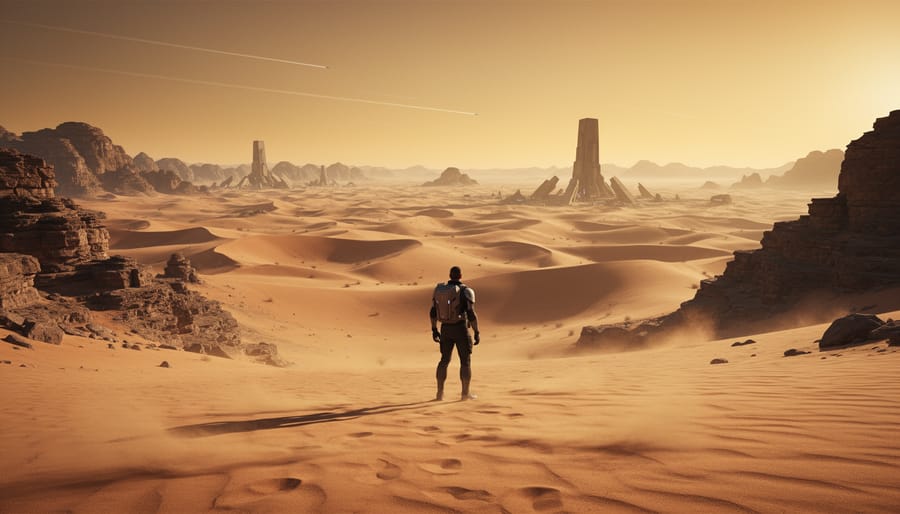
Gareth Edwards’ The Creator arrives on Prime Video as a visually stunning meditation on artificial intelligence that refuses easy answers. Set in a future where the U.S. wages war against AI-powered nations, the film follows an ex-special forces agent tasked with hunting down the architect of advanced AI, and the mysterious weapon that could end the conflict. What distinguishes The Creator from typical AI thrillers is its reversal of expectations: rather than positioning artificial beings as the threat, Edwards explores how fear and prejudice drive humanity’s destructive impulses.
The film’s greatest achievement might be its visual effects, which rival studio tentpoles despite a modest budget. Edwards shot on location across Southeast Asia, grounding the futuristic world in tangible environments that feel lived-in rather than sterile. The result is sci-fi that breathes, where high-tech weaponry coexists with rice paddies and rural villages. This aesthetic choice reinforces the film’s central question: when AI beings exhibit consciousness, emotion, and relationships, what separates them from us, and who gets to decide who deserves to exist?
Epic Blockbusters and Franchise Favorites
7. Avengers: Endgame, The MCU’s Crowning Achievement
When time travel meets superhero spectacle, you get cinema’s most ambitious puzzle-box finale. Avengers: Endgame rewinds through the MCU’s greatest hits while pushing the emotional stakes higher than any previous entry, making it both a love letter to long-time fans and a surprisingly effective sci-fi thought experiment about consequence and sacrifice.
The time heist concept transforms what could’ve been a simple rematch into something genuinely science fiction, characters confront younger versions of themselves, wrestle with the butterfly effect, and face the quantum mechanics of undoing Thanos’s snap. Directors Anthony and Joe Russo ground the reality-bending plot in character moments that earn the payoff: Tony Stark reconciling with his father, Thor confronting his failures, and Steve Rogers finally getting that dance he was promised.
What elevates Endgame beyond typical superhero fare is its willingness to treat time travel rules seriously while never losing sight of human stakes. The three-hour runtime gives space for grief, humor, and sacrifice to breathe between the massive set pieces. That final battle delivers visual spectacle on an unprecedented scale, but it’s the quieter moments, a hologram message, an old photograph, a shield passed to a new generation, that linger longest. This isn’t just a satisfying conclusion to a decade-long story; it’s a meditation on legacy, loss, and what we owe the future when we can rewrite the past.
8. Dune: Part Two, Continuing the Desert Epic
Denis Villeneuve’s continuation of Frank Herbert’s saga expands far beyond the first film’s introduction to Arrakis. Where the 2021 original established Paul Atreides’ exile and awakening in the desert, Part Two plunges into his transformation into Muad’Dib and the escalating conflict with the Harkonnens and the Emperor. The sequel delivers breathtaking sequences that dwarf even its predecessor’s scale, particularly the massive sandworm-riding scenes that Herbert fans waited decades to see realized properly on screen.
What makes this sequel essential viewing isn’t just its visual spectacle. Villeneuve deepens the moral complexity of Paul’s journey, refusing to paint his rise as straightforward heroism. The film wrestles with uncomfortable questions about prophecy, manipulation, and the cost of messianic leadership. Zendaya’s Chani steps forward from the margins into a central role, grounding the cosmic stakes in genuine human emotion. The expansion of the Fremen culture adds layers of ritual and tradition that make Arrakis feel like a living world rather than a desert backdrop.
For anyone who appreciated the first film’s measured pacing and world-building, Part Two rewards that patience with payoffs both spectacular and thought-provoking.
9. Ad Astra, Solitary Journey to the Stars
Ad Astra strips away the explosive spectacle often associated with space epics and instead delivers an introspective meditation on isolation, father-son relationships, and what we’re really searching for when we look to the stars. Brad Pitt’s understated performance as Roy McBride anchors this deliberately paced journey to the edge of the solar system, where personal demons prove more dangerous than cosmic threats.
The film’s greatest strength lies in its willingness to embrace silence and emptiness. Long stretches unfold without dialogue, letting the vastness of space mirror Roy’s emotional detachment. Director James Gray uses the familiar sci-fi framework of a rescue mission as scaffolding for a psychological descent, turning each planetary stop into a confrontation with isolation, duty, and the myths we build around absent parents.
What makes Ad Astra compelling for thoughtful viewers is its refusal to provide easy answers or neat resolutions. The film questions whether humanity’s push outward into space might sometimes be an escape from inner work rather than genuine exploration. It’s not a crowd-pleaser, but for those craving science fiction that privileges character depth over action beats, this contemplative voyage rewards patience with genuine emotional resonance and stunning visuals that capture both the beauty and terror of cosmic solitude.
Fresh and Emerging Sci-Fi
10. Mickey 17, Dark Comedy Meets Sci-Fi Thriller

Mickey 17 brings Bong Joon-ho’s signature dark humor and social commentary to the science fiction thriller space. The film follows a disposable employee sent on a dangerous space colonization mission, where he’s routinely cloned after each death, until an unexpected glitch creates two versions of him simultaneously. What makes Mickey 17 compelling is how it uses its high-concept premise to explore exploitation, identity, and survival with the same sharp wit that made Parasite resonate so deeply. The performances balance absurdist comedy with genuine emotional stakes, while the production design creates a grimy, lived-in future that feels more plausible than polished. It’s sci-fi that refuses to take itself too seriously while still delivering thought-provoking questions about what makes us human and how systems treat workers as expendable.
11. Companion, New Take on AI Relationships
“Companion” arrives on Prime Video’s 2026 sci-fi lineup as a thought-provoking entry in the AI relationship subgenre, though it distinguishes itself from familiar territory like “Her” or “Ex Machina” by examining the messier, more uncomfortable dynamics of human-AI attachment. The film doesn’t offer easy answers about whether artificial companionship can substitute for human connection, instead, it leans into the ethical gray zones and emotional complications that arise when loneliness meets algorithmic precision. What makes it worth your time is its willingness to explore the power imbalances inherent in relationships where one party is literally programmed to please, raising questions about consent, autonomy, and the nature of genuine intimacy. The film’s quieter moments, where characters confront what their reliance on AI companionship reveals about themselves, carry more weight than the technological speculation.
12. Backrooms, Internet Horror Comes to Life
The viral “Backrooms” phenomenon, endless yellow hallways, fluorescent hum, and the dread of being trapped in a liminal space, has haunted internet users for years, and this Prime Video adaptation brings that unsettling concept to the screen with surprising effectiveness. The film leans into the source material’s core tension: the disorienting sense of being somewhere familiar yet fundamentally wrong, where navigation follows dream logic and escape feels impossibly distant. Rather than overexplaining the mythology, it trusts viewers to bring their own knowledge of the lore while building genuine atmosphere through sound design and uncomfortably sterile visuals. The result is a slow-burn psychological thriller that works whether you’re a longtime fan of the internet horror or approaching it fresh. It won’t satisfy viewers craving traditional monster scares, but if you appreciate horror that crawls under your skin through mood and dread, this adaptation captures what made the concept resonate in the first place.
13. Disclosure Day, First Contact Reimagined
What if humanity’s first contact with extraterrestrial intelligence didn’t unfold through grand speeches at the United Nations, but through the intimate, messy reality of ordinary people thrust into extraordinary circumstances? Disclosure Day takes that premise and runs with it, stripping away the typical Hollywood spectacle to examine how first contact might actually feel on a human scale. Rather than focusing on government conspiracies or military responses, the film explores the psychological and social upheaval when confirmation of alien life becomes undeniable, the conversations around dinner tables, the fracturing of relationships, the sudden irrelevance of long-held beliefs.
The film’s strength lies in its restraint. There are no massive spacecraft hovering over cities or laser-filled battles. Instead, Disclosure Day builds tension through what remains unseen and unknown, following characters who must navigate a world where the rules have fundamentally changed overnight. It’s a quieter, more introspective take on a genre that often defaults to explosions and heroics, making it perfect for viewers who appreciate science fiction that lingers in your thoughts long after the credits roll.
14. Predator: Badlands, Franchise Evolution
The Predator franchise gets a fresh direction with Badlands, now streaming on Prime Video. This installment takes a bold creative swing, shifting the formula that’s defined the series since 1987. Rather than simply dropping the iconic alien hunter into yet another survival scenario, Badlands explores new narrative territory within the franchise mythology.
What sets this entry apart is its willingness to experiment with perspective and setting. The film doesn’t just rehash familiar beats, it challenges what a Predator movie can be while respecting the creature’s established lore. The result feels both familiar to longtime fans and accessible to newcomers discovering the franchise through Prime Video’s catalog.
For sci-fi enthusiasts tired of predictable franchise entries, Badlands offers something genuinely different. It’s a reminder that long-running series can still surprise when filmmakers trust audiences to embrace evolution over repetition.
15. The End of Oak Street, Indie Sci-Fi Gem
Sometimes the best sci-fi doesn’t need a massive budget, it just needs a smart script and a compelling vision. The End of Oak Street proves that point beautifully. This indie offering leans into atmosphere and character-driven storytelling rather than CGI spectacle, crafting a narrative that lingers long after the credits roll.
The film’s smaller scale actually works to its advantage, allowing it to explore its premise with intimacy and nuance that blockbusters often sacrifice for explosions. Without relying on familiar franchise IP or A-list names, it earns every emotional beat through careful world-building and performances that feel genuinely human, even when grappling with distinctly sci-fi concepts.
What makes The End of Oak Street particularly rewarding is its willingness to trust the audience. It doesn’t over-explain its mechanics or pander with unnecessary exposition dumps. Instead, it invites you to piece together its mystery organically, respecting your intelligence while delivering genuine surprises.
For viewers tired of formulaic studio fare, this represents exactly the kind of discovery Prime Video’s catalog enables, a hidden gem that might otherwise never reach your radar.
Making the Most of Your Prime Video Sci-Fi Journey
Finding your next great sci-fi watch on Prime Video doesn’t have to mean endless scrolling. Start by heading to the Science Fiction genre page, which organizes hundreds of titles into a browsable collection. The search bar is more powerful than you might think, try specific terms like “space opera,” “time travel,” or “cyberpunk” to narrow down the massive library to exactly what you’re craving.
Prime Video’s filtering options let you sort by release year, which is perfect when you want to compare how the genre has evolved or stick to a particular era. Check the “Customers Also Watched” section at the bottom of any film’s page for algorithm-driven recommendations that often surface hidden gems you wouldn’t find through browsing alone.
Don’t sleep on community engagement. Rating the films you watch helps Prime Video fine-tune its recommendations for you, while browsing user reviews can reveal whether a promising title delivers on its premise or falls flat. Join the conversation in the comments section below to swap recommendations with fellow sci-fi fans, sometimes the best discoveries come from readers who share your exact tastes.
Your Sci-Fi Questions Answered
How do I find the newest sci-fi releases on Prime Video?
Navigate to the Prime Video homepage, select “Movies,” then choose “Science Fiction” from the genre menu. You can sort results by “Release Date” to see the latest additions, though Prime Video updates its catalog regularly throughout the year.
Do classic sci-fi films rotate in and out of Prime Video?
Yes, streaming availability changes as licensing agreements expire and renew. Titles can shift between included with Prime membership and available for rent or purchase, so favorites like Close Encounters of the Third Kind may not always be freely available.
What if I want cerebral sci-fi instead of action blockbusters?
Look for films like Mr. Nobody or Cloud Atlas that prioritize philosophical questions and narrative complexity over spectacle. The Prime Video search function lets you read plot summaries before watching, helping you identify thought-provoking stories versus action-driven ones.
Can I watch sci-fi films offline on Prime Video?
Prime Video allows downloads on mobile devices through its app, perfect for watching during flights or commutes. Check whether specific titles support offline viewing by looking for the download icon next to each film.
Beyond these basics, remember that Prime Video’s interface can feel overwhelming when you’re browsing hundreds of titles. Setting up a watchlist helps you save interesting films for later rather than losing track of discoveries. You can also check external sites like Rotten Tomatoes, which maintains curated lists of the best sci-fi movies available on Prime Video in 2026, offering a second opinion when you’re unsure what to watch next.
The genre categories on Prime Video sometimes overlap, so don’t limit yourself to just the Science Fiction section. Horror-sci-fi hybrids like Event Horizon might appear under both genres, and some newer releases get featured in “Recently Added” before they’re properly categorized.
Your Next Sci-Fi Adventure Awaits
Whether you’re drawn to Spielberg’s sense of wonder, cerebral puzzles that bend reality, or blockbuster spectacle that pushes visual boundaries, Prime Video’s 2026 sci-fi catalog has carved out space for every type of viewer. The fifteen films we’ve explored here represent just the beginning of what’s available, spanning eras from 1977’s groundbreaking contact stories to this year’s fresh takes on AI, horror, and first contact scenarios.
The beauty of having this much variety in one place is the freedom to experiment. If you typically stick to action-heavy franchise entries, try a contemplative journey like Ad Astra. Prefer cerebral narratives? Event Horizon might show you what happens when sci-fi embraces pure dread. Each film opens a door to something different, and your next favorite might be one genre-hop away.
We’d love to hear what resonates with you. Drop a comment below with your pick from this list, or share a hidden sci-fi gem on Prime Video that deserves more attention. The best recommendations often come from fellow viewers who’ve done the digging, so let’s keep the conversation going and help each other find those unexpected treasures waiting in the catalog.